

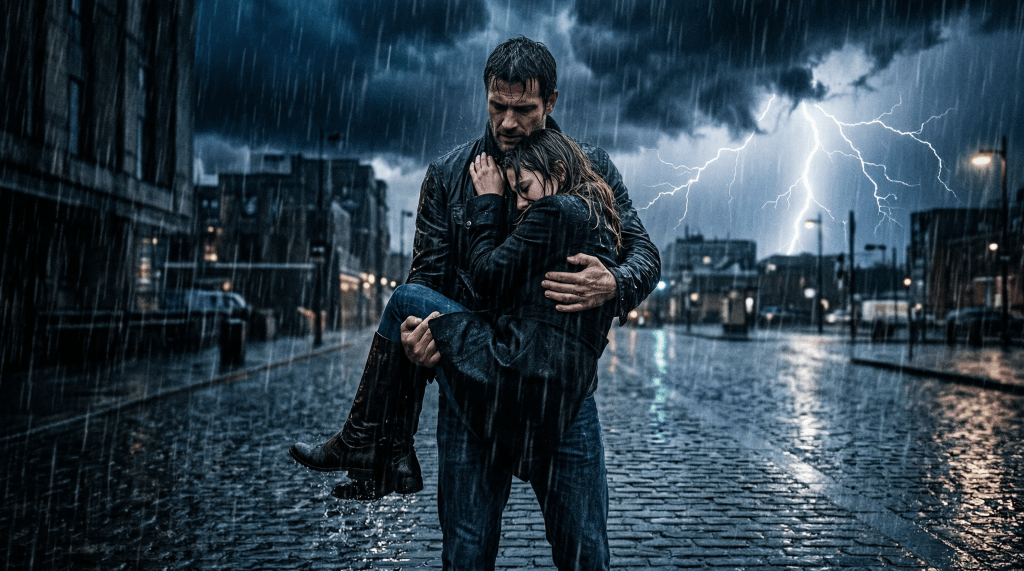
On staying when leaving would be easier. On solitary. On ten years of real love that doesn’t stop being real because of a mental break from reality.
By Simon Sherr — The Gray Jedi
I am writing this from a townhouse on a golf resort.
Not because I am on vacation. Because three weeks ago my life came apart in ways I am still assembling into a coherent sentence.
My wife — the person I have written well over 300 love letters to from single words, the person I have written and published more than 30 songs for, the person I chose every single day for ten years — is having a mental health crisis. A serious one. The kind that doesn’t announce itself politely. The kind that builds in the walls for years before it comes through them.
And I am here, on a golf course I am not playing, writing about what it means to love someone whose illness will not let them feel it.
What I Thought Was Us Fighting
We didn’t fight. For the last 8 years. That is not an exaggeration or a romantic revision — we genuinely did not fight. We had the kind of marriage that made other couples quietly uncomfortable. Our home is a “Shrine to our Love” a friend once said along with “We get it… you love each other.”
What I understand now — sitting with the clarity that only complete upheaval provides — is that what I thought was harmony was sometimes something else. Mini breaks. Small departures from reality that I absorbed, managed, worked around. Word of the Day. Songs. Patience. Love applied like a bandage to something that needed a surgeon.
I am not saying the love wasn’t real. The love was the realest thing in my life.
I am saying love is not a treatment plan.
The Part I Have To Tell You About
On March 13th I was arrested.
I won’t bury that or dress it up. I was arrested on a domestic violence call that I did not understand — because there was no domestic violence. What there was, was a woman in a mental health crisis who called police during an episode and a system that had one protocol and applied it.
The charges were dropped. There was no order of protection. The case does not exist in any meaningful legal sense.
What does exist — what I carry in my body right now — is four days in solitary confinement.
I want to be careful here because I am not writing this for sympathy and I am not writing it to be graphic. I am writing it because if you have never been in a small concrete room, naked, handcuffed and assaulted, a dislocated thumb, the worst bruises I have ever had in my life (and that’s saying something as a former MMA fighter and Kickboxer) with no information, no contact, no explanation, no charges, no lawyer, no phone call, listening to mothers cry for their children through the walls at night while a voice from the cell next to yours tells you matter-of-factly that people die in these cells —
You do not know what your nervous system is made of until you find out.
I found out.
By day two I had stopped waiting for rescue and started owning the space. By day three I was something I don’t have a clean word for — not broken, not fine, something harder and quieter and more certain. The men on the other side of that door were afraid of the man inside it. That is not the outcome anyone expected, including me.
I came out changed. Not damaged. Changed.
And the first coherent thought I had when I walked into daylight was: I need to get Shona help.
Not anger. Not recrimination. Not the very reasonable and human response of she did this to me.
My wife is sick. She needs help. That was the whole thought.
What Mental Illness Actually Looks Like From The Outside
Here is what nobody tells you about loving someone with untreated mental illness:
It is invisible until it isn’t.
You see the person you love — funny, warm, brilliant, the one who makes sense of the world in ways no one else does. And underneath that, building pressure you cannot see, is a brain that is quietly rewriting reality. Not lying. Not choosing. Rewriting.
My wife is not a bad person. She is a sick person who has been sick for both her marriages. Her ex described symptoms consistent with a personality disorder, but in my experience of her, she has been terrified of abandonment — and that fear doesn’t fit the classic profile. Whatever name the illness has, it is real, and it is not who she is. The posts on social media that her friends are calling me about. The reality that bends at the edges and then bends more. The crisis that lives just below the surface of the calm, waiting for a trigger that doesn’t have to make sense to be real to her.
This is not who she is. This is what is happening to her.
The cruelty of mental illness — the specific, exquisite cruelty of it — is that it takes the person you love and puts them somewhere you cannot reach. Not gone. Somewhere. And the illness tells them you are the threat, you are the one who cannot be trusted, you are the thing to move away from.
So the person whose arms you need to be in is being told by their own brain that your arms are the danger.
There is no clean response to that. There is only staying in the vicinity of the door and hoping it opens.
Why I Am Not Leaving
People keep asking me this. Friends who have reconnected. People who know the outline of what happened. They ask with love, not judgment — they ask because they care about me and the outline is alarming.
Here is my answer:
Mental illness is not a character flaw. It is not a choice. It is a brain doing something the person inside it did not ask for and cannot simply decide to stop.
I did not fall in love with a well person who became difficult. I fell in love with a whole human being — and part of that human being is a brain that needs help it hasn’t gotten yet.
Leaving because she is sick feels like leaving someone in a burning building because the smoke is bothering me.
Now — I want to be honest here, because this blog has always been honest — I am not saying this position is without cost. It has cost me significantly. The golf resort is evidence of that. The four days in solitary are evidence of that. Losing my job as a result is evidence of that.
What I am saying is that the cost does not change what is right.
She needs a diagnosis. She needs a treatment plan. She needs medication managed by someone who knows what they are doing. She needs therapy. She needs the kind of help that is not a husband with a word of the day and an acoustic guitar — as much as I believe in both.
I am fighting for her to get that help. Not from inside the marriage right now — I am not inside the marriage right now — but from the position of someone who loves her and is not going to pretend otherwise because it would be more convenient.
The Ten Years
I need to say this clearly because I think it matters.
Ten years of real love is not erased by illness — not even the first break where music and poetry couldn’t find her.
We dreamed the same house before we met. Literally — the same house, a plantation near a river, a rectangular pool at the bottom of steps down a slope. We compared notes years later and looked at each other with the specific expression of two people who understand that some things are not coincidences.
She is the reason I know how to love well. She is the reason I know what it feels like to be chosen, to be seen, to be home. Whatever is happening in her brain right now — whatever the illness is doing to her perception of reality and of me — it does not reach back through ten years and unmake them.
Those years happened. They are permanent.
The love is permanent.
She is permanent, underneath the illness. The real her. The one who taught me things about love I did not know were possible. She is still in there, behind whatever the brain is doing right now, and I am not willing to write her off because her illness is loud.
What I Want For Her
I want her to sleep. She hasn’t been sleeping properly and sleep deprivation does things to human neurology that look indistinguishable from psychosis — I know this from the inside, more intimately than I would choose.
I want her to see a doctor. Not an ER doctor in a crisis. A psychiatrist who will sit with her over time and understand what is actually happening and give it the right name and the right treatment.
I want her to be well. Not well enough to come back to me — well enough to be herself. Well enough to feel the ten years without the illness distorting them. Well enough to look at her life and see it clearly.
If she gets well and looks at her life clearly and decides she doesn’t want to come home — that is a decision I will respect. A real decision, made by a well mind, deserves respect.
But right now she is not making decisions. Her illness is making decisions. And I am not going to treat those decisions as final.
If You Are Reading This And You Recognize Someone
Mental illness in someone you love is one of the loneliest experiences available to human beings.
You cannot fix it. You cannot love it away — I tried, for years, with everything I had, and I am telling you this as a man who loves well and knows it. You cannot absorb it indefinitely without it costing you. And you cannot make someone seek help who has decided — or whose illness has decided for them — that help is not needed.
What you can do:
Stay close to the door. Keep the light on. Make sure they know — in whatever way gets through — that you are not the threat their illness is telling them you are.
Get your own support. This is not weakness. This is maintenance. A fire that burns at both ends goes out. You are not useful to the person you love if you are ash.
Know the difference between loving someone and enabling their illness to hurt you. These are not the same thing. One is noble. One is a slow catastrophe that helps no one.
And — this is the hard one — understand that their getting help is ultimately not in your control. You can create conditions. You can hold the door open. You can refuse to close it. But you cannot walk through it for them.
The walking is theirs to do.
What Comes Next
I don’t know.
That is the honest answer and I think honest answers matter more than reassuring ones, especially here.
I know I love her. I know the illness is real and treatable and not her fault. I know that four days in solitary did not make me want to leave — if anything it clarified exactly how much I am not leaving, because my only thought during PTSD flashbacks was my Shona. I sang the songs I wrote for her for hours every night. She was the one thing that made me not drown myself in a toilet or just let the Sherrifs end my life as I “resisted” (which seemed like what they were going for). My first thought in daylight was about getting her help and that tells me everything I need to know about where I stand.
I know that ten years of real love does not go quietly. Everyone who knows me, knows I don’t leave anything I don’t want to leave… quietly. Real love stays in the vicinity of the door. It keeps the light on. It writes blog posts at whatever hour it needs to write them because writing is how it processes and processing is how it survives.
I know that she is somewhere in there, behind the illness, and she is worth waiting for.
That has to be enough for today.
Because today — the golf resort, the clarity, the strange quiet of a man who has been through fire and solitary and upheaval and come out the other side still standing, still in love, still reaching toward the door —
Today, that is enough.
I love you. Come home when you can.
— Simon
Simon Sherr is a systems designer, inventor, Vajrayana Buddhist, and founder of Valkyrie Labs. He writes about consciousness, physics, love, and the places where they overlap under the name The Gray Jedi. He is fine. He is not fine. He is both, simultaneously, which is apparently what being human looks like when you pay attention.
If someone you love is showing signs of a mental health crisis, the 988 Suicide and Crisis Lifeline is available by call or text. You can also reach NAMI — the National Alliance on Mental Illness — at nami.org.
 TheGrayJedi