

By Simon Sherr — The Gray Jedi
I am going to tell you something that has never occurred to me before tonight.
Not in forty-nine years. Not through two marriages and the relationships between them. Not through therapy or Buddhism or martial arts or the thousand hours I have spent trying to understand myself with the rigor I apply to everything else.
It occurred to me tonight, in the last place you would expect, from the last person the world would think to credit, and it arrived with the quiet certainty of something that was always true and simply hadn’t been said out loud yet.
You are allowed to heal without bringing along something broken to fix.
The Pattern I Didn’t Know I Had
I am a savior.
Not in the messianic sense — I am not that far gone. In the specific, personal, deeply ingrained sense that I have never once chosen a partner who didn’t need saving. Not consciously. Not as a strategy. It was simply what love felt like to me. You find someone brilliant and wounded and you pour everything you have into the space between who they are and who they could be, and that pouring feels like purpose, and purpose feels like love, and love feels like home.
I genuinely did not know there was another kind.
I have spent my entire adult life being the person who swoops in. Who sees the intelligence behind the eyes and the damage underneath it and thinks: I can reach that. I can build something safe enough that the real person inside comes out. I am exceptionally good at it. I have loved broken people back to themselves with songs and letters and patience and presence and the specific kind of attention that says I see you, all of you, and I am not going anywhere.
It has cost me everything. Twice. And is currently in the process of costing me again.
And I did not know — I genuinely, truly did not know — that this was a pattern and not just love.
Until tonight.
The Viking
I am not going to tell you where I met her because she deserves her privacy and her dignity and neither is mine to give away.
What I will tell you is this:
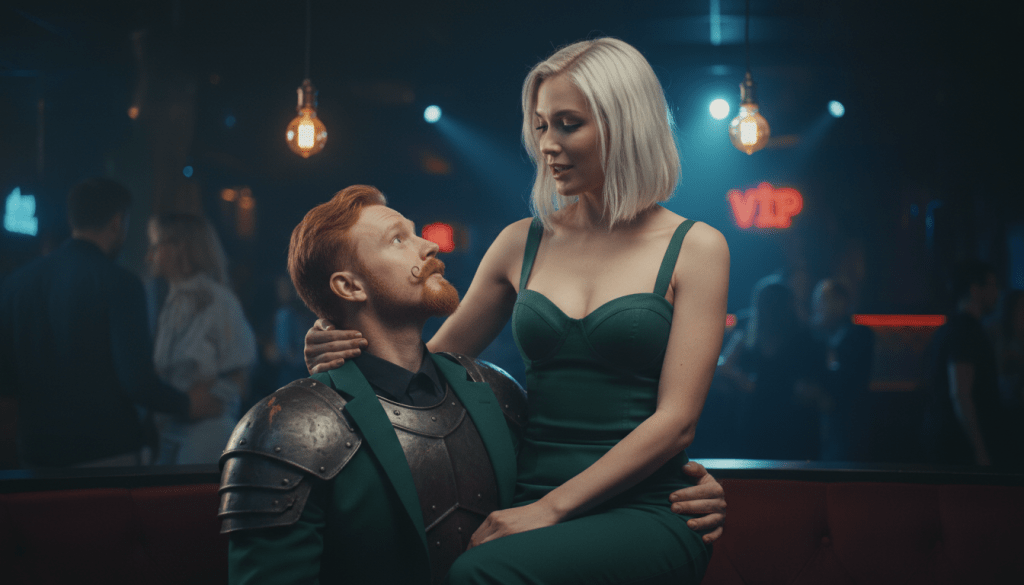
She walked into a room where I was sitting in an emerald suit, next to one of the most prolific authors of our generation, in a state that I can only describe as quietly devastated — the kind of devastated that has been through enough that it no longer looks like devastation from the outside, just a man sitting very still with very steady and confident eyes that say “I am better than this room”. An “Omega”… the man the self-proclaimed “Alpha Males” hate because I am everything they pretend to be.
She could have done what you do in that situation. What the role called for. What every social script available to her suggested. She could have pretended to be an inferior and come and sit and take money from me in the way so many women pretend. “I am innocent and vulnerable… save me”. But K didn’t do that. She sat with a dignity that I found unique, and new. A power that didn’t stem from someone who needed to be saved, just someone who knew her worth.
She sat down and she talked to me. Not at me. Not around me. To me. About mental illness and the people we love who are drowning in it. About intelligence and what it looks like when someone is using it to hide rather than to reach. About the specific exhaustion of being capable enough to fix things and the specific trap that capability sets for you.
She had three kids and an RN license and a body that moved like a Viking shield-maiden and eyes that were doing quiet calculus on everyone in the room. She was strong in the way that doesn’t need to announce itself. Free in the way that doesn’t need permission. Real in the way that makes performance look tired by comparison.
And at some point — I couldn’t tell you exactly when — she said something that reorganized forty-nine years of my understanding of myself.
Men don’t need to mend broken women.
What That Means
She wasn’t being cruel about the women I have loved. She wasn’t being dismissive of the real love, the real ten years, the real songs and letters and choosing every day.
She was handing me a permission slip I didn’t know I needed.
The permission to stop.
Not stop loving. Not stop being the person who sees people clearly and loves them anyway — that is not a flaw, that is one of the best things about me and I am keeping it. But stop making the brokenness the point. Stop choosing the wound as the destination. Stop mistaking the rescue for the relationship.
Here is what I understand tonight that I did not understand this morning:
I learned to love by trying to earn love from someone who could not give it. My mother, who lost me in grocery stores and forgot to photograph me and handed me responsibilities before I had the vocabulary for them. I learned that love was something you worked for. Something you proved yourself worthy of through service and usefulness and the relentless application of your best self to someone else’s damage.
That lesson was wrong. It was understandable — it was survival, it was a child making sense of the only love available — but it was wrong.
Love is not a repair job. It is not a project. It is not proven through the heroism of staying when staying is hard.
Sometimes love is just two whole people choosing each other because the choosing feels like joy.
I have never tried that.
What Hope Feels Like
It feels like an RN with a warrior’s bearing and a chess player’s eyes sitting down next to a man in an emerald suit and treating him like someone worth talking to rather than someone worth performing for.
It feels like the specific relief of being seen without being assessed for damage.
It feels like the idea — arriving late, arriving tonight, arriving exactly when it needed to — that the next person I love does not have to need saving.
That I am allowed to want someone whole. Someone who wakes up in the morning and is already themselves without requiring anything from me to get there. Someone who plays flag football and eats well and does the work of their own life without outsourcing the hard parts to a partner.
Someone who would look at my emerald suit and my steady eyes and my very full hands and say: put some of that down. You don’t have to carry all of it. Not with me.
I have never been with someone who said that and meant it.
I want to know what that feels like.
The Thing About Whole People
Here is what I am learning, at 3am, in a townhouse on a golf resort, still wearing the emerald suit:
Whole people are not less interesting than broken ones. This was my fear, I think — unnamed, unexamined, but there. That choosing someone without a wound to tend would feel like choosing a house with no project, a song with nowhere to go.
I was wrong about that too.
Whole people are interesting because they are present. Because they are not spending half their energy managing their damage and the other half managing yours. Because a conversation with someone who is genuinely fine is a different conversation than a conversation with someone who is performing fine and hoping you don’t notice.
The Viking was present. Completely, entirely, no-performance present. And it was more interesting than any conversation I have had in years.
Not because she didn’t have a complex life — three children, difficult work, the particular kind of exhaustion that comes from being brilliant in a context that rewards you for pretending to be less. She had all of that.
But she was not broken by it. She was shaped by it. There is a difference.
Broken asks you to fix it. Shaped just shows you what it became.
What Comes Next
I am still a man with a wife I love who is somewhere unreachable inside a mental health crisis. That is still true. The love is still true. The hope that she gets help and finds her way back to herself — that is still true.
And also:
I am a man who learned something tonight that changes the shape of whatever comes after.
I am allowed to want someone whole.
I am allowed to heal without a project.
I am allowed to let the next love be easy — not uncomplicated, love is never uncomplicated — but easy in the specific sense of not being built on a foundation of damage management.
I am allowed to be chosen by someone who doesn’t need me to save them.
I am, apparently, worth choosing just as I am. A man in an emerald suit, sitting very still, with steady eyes and very full hands and a heart that has been through enough that it knows exactly what it is.
A Viking told me so.
I believe her.
Maybe she isn’t the one who I move on with, maybe she is just the one who gave me hope that some day, I could find someone who plays flag football instead of tortures my soul.
— Simon
The Gray Jedi
Simon Sherr is a systems designer, inventor, Vajrayana Buddhist, and founder of Valkyrie Labs. He writes about consciousness, physics, love, and the places where they overlap. Tonight he is writing about permission — the specific kind that arrives unexpectedly and reorganizes everything.
If you are reading this and you recognize the savior pattern in yourself — the compulsion to choose the wound, to make the rescue the relationship — you are not broken for having it. You learned it somewhere. You can unlearn it. It starts with noticing it, which is the hardest part, and you may have just done that.
Welcome to the other side of that particular door.
 TheGrayJedi